

Invited: Reviewed by Jon Isbell on October 20, 2026
Three familiar names in North East theatre – Live Theatre, Eastlake Productions, and Newcastle Theatre Royal – have joined forces to present Our Friends in the North: The Thatcher Years, celebrating 30 years since the BBC drama first hit the nation’s screens. This much-loved and critically acclaimed series, spanning three decades from 1964 to 1995, began life as an RSC-produced play, with the action ending at the 1979 general election. This new production allows writer Peter Flannery to bring the years 1979 and 1984 to the stage for the first time. This is a play that feels absolutely at home in Newcastle and the audience reaction is no doubt bolstered by that sense of hometown pride. I’m sure that many audience members hold fond memories of the TV series, and many will also hold memories – though perhaps not so fond – of the dark times portrayed.


For the benefit of those who are perhaps not familiar with the TV series narration is ably provided through Wallsend-born actor Trevor Fox. As well as playing the role of Felix – Nicky’s ageing father – Fox slips into various guises throughout, providing much of the play’s comic relief as the only actor to break the fourth wall. That comic relief is perhaps needed. As those familiar with the TV series can attest, the material can be heavy, and comedy was hardly a priority in the source material. The script is careful and clever in its use of comedy, however, with the second act allowing itself to take on the darker elements of the story. Rightly so given it covers the harrowing experiences of the 1984 miners’ strike, a topic that remains deeply felt across North East communities. Any sympathetic telling of these times will strike a chord with an audience in the area, and when it is told as well as this, the standing ovation given tonight feels thoroughly deserved. It would be interesting to see how the play is received in other regions. I have no doubt it would be received favourably, but the scars of a painful collective history and a lingering sense of injustice surely do a little extra heavy lifting on home turf.


Our four main characters – Mary, Nicky, Tosker, Geordie – are played respectively by Sam Neale, Ryan Nolan, Jack Robertson, and Scott Turnbull. Notably, each is given free rein to make the characters their own rather than attempt to mimic or caricature the original performances, letting Flannery’s script bring the recognisable qualities of the characters to life, and all four do an excellent job. Neale communicates Mary’s sensitivity while simultaneously giving her the strength of character that sees her through. Nolan embodies Nicky’s optimism and ultimate sense of futility masterfully. Robertson brings an unexpected humour and humility to Tosker, and those who saw him in Eastlake Productions’ Gerry and Sewell will recognise his innate ability for comic timing, shoulder to shoulder with pathos. Turnbull as Geordie provides the audience with perhaps the most tragic trajectory, navigating the character’s descent in such a way that his outcome feels at once inevitable and surprising.


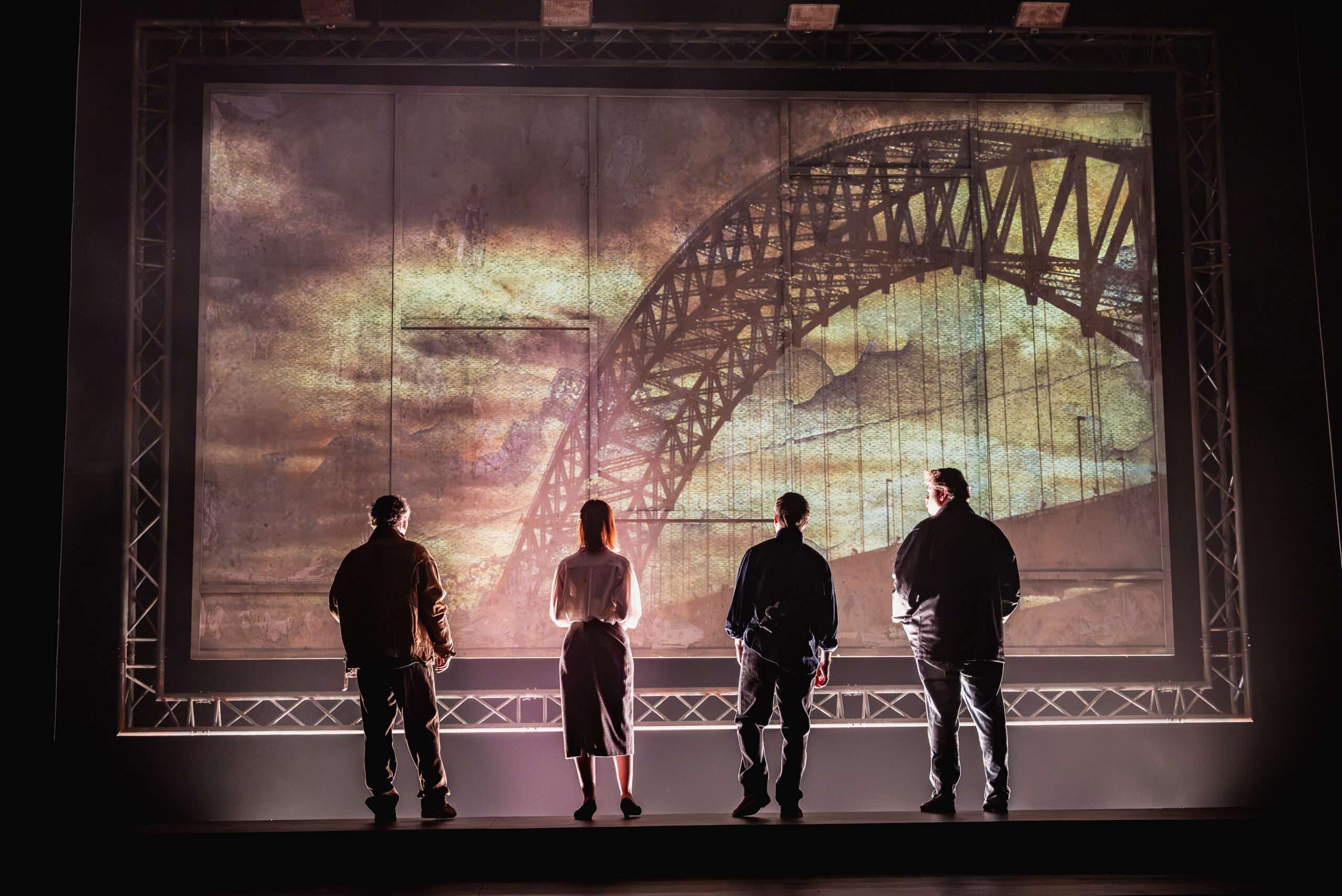
Flannery has woven recognisable moments from the series into his play and director Jack McNamara has allowed those scenes to breathe on their own. Amy Watts’ simple set design allows McNamara to move the actors deftly around the performance space to create the different settings required without the need for large set pieces, clunky scene changes, or laborious blackouts. Coupled with lighting design from Drummond Orr and movement work by Alicia Meehan, the second act in particular finds effective, impactful ways to tell the story. Heather Scott’s video design complements the production wonderfully, providing accurate historical support to the plot as well as emotional context to some scenes.


Photo credits: Chris Bishop
This is a play well worth seeing whether familiar with the TV series or not. Many of the issues on display still feel relevant in today’s political climate. Indeed, it shows that what many see as a modern curse, politics of personality over substance, has been around for many decades. It shows that the control of information which younger generations may put down to social media algorithms was always at the heart of the control of power. It shows that the North–South divide, to which so much election campaign rhetoric has been dedicated in recent years, was perhaps even more stark when the decimation of entire communities in the North was being overseen by the powers-that-be in the South. But above all, I think this play shows that people have the ability to survive. Their way of life, their views and opinions, their very existence – all of these may be challenged and push them to the brink of despair and destruction, but in some form or another these characters endure. For better or for worse.
Our Friends in the North: The Thatcher Years runs until Saturday 24th October 2026 tickets from theatreroyal.co.uk
Discover more from InNewcastle.co.uk
Subscribe to get the latest posts sent to your email.