
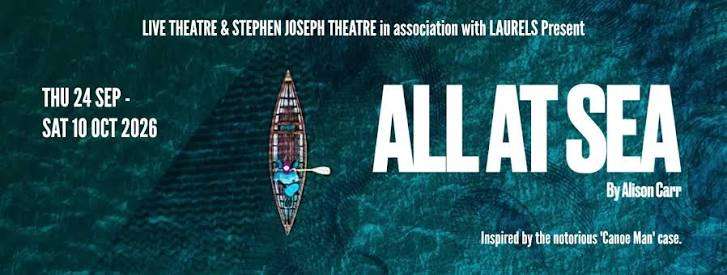

Invited: Reviewed by Jon Isbell on 29 September 2026
While heavily inspired by the real events of “canoe man” John Darwin and his (now ex) wife Anne Stephenson, ‘All At Sea’ is nonetheless a work of fiction. It takes the scenario of a couple seeking to fraudulently claim life insurance by faking the man’s death and deftly turns it into a study in marriage, coercion, pride, identity, self-worth, and social expectation.


The play is a single-act two-hander, set entirely within the convincingly middle-class living room of Colin and Deborah – a location perfectly brought to life by set designer Hannah Sibai, with a nice little surprise element hidden away at first and used to great effect as the plot develops. Lighting design by Catja Hamilton helps guide the audience through the non-linear narrative as the players navigate their space on stage between vignettes.


Phil Corbitt as Colin and Sarah Belcher as Deborah provide a believable dynamic, increasingly so as we gradually learn the ins and outs of their relationship and their history. Corbitt gleefully portrays the fanciful whims of a man refusing to live under the shadow of his own father’s mistakes while progressively revealing the level of control and coercion the character has exerted over his wife and how that coercion escalates towards the inevitable climax. I say inevitable – Belcher’s treatment of her character is so wonderfully constructed that the audience are on more than one occasion led to question just how far Deborah will follow her man, just how much she can take and, judging by the multiple viewers who left their seat saying, “wouldn’t have got that far with me!”, how far they themselves would have gone.


Photos: Von Fox Productions
Deborah is in the unusual position of not only being able to find out who she is without her husband but also being able to make a direct comparison to who she is with him. Had Colin actually died, perhaps Deborah would never have had the same opportunity to discover who she truly was without him, nor to recognise the destructive patterns of their marriage. Colin, on the other hand, becomes the victim of his own scheme. Trapped within a cage of – quite literally at times – his own creation, he descends into an ever-expanding delusion of grandeur, ultimately finding himself isolated from the very society whose recognition of his success and affluence he so desperately craves.
Both characters have become trapped by the identities they have constructed within their marriage. Their conspiracy sets those identities on a collision course, eventually pushing each to their own breaking point.
Discover more from InNewcastle.co.uk
Subscribe to get the latest posts sent to your email.