
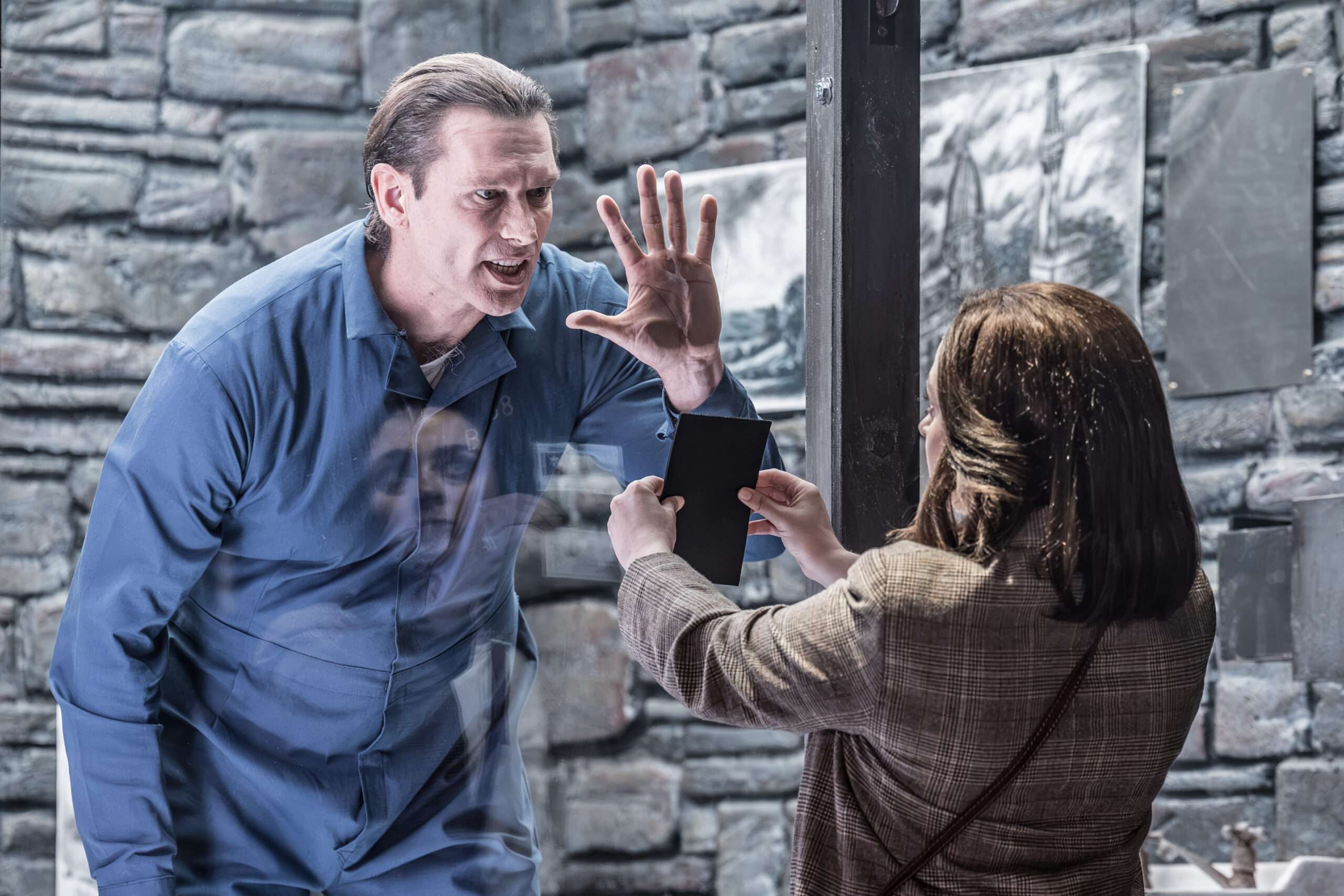

Clarice Starling and Dr Hannibal Lecter will face off on stage in a spine-tingling new theatrical adaptation of Thomas Harris’s multi-million-selling novel The Silence of the Lambs. This gripping psychological thriller visits Newcastle Theatre Royal (Tue 18 – Sat 22 Aug 2026).
The cast is led by star of stage and screen John Partridge (Cats, EastEnders) as Hannibal Lecter, Mollie Gallagher (Coronation Street) making her professional theatre debut as Clarice Starling, Oliver Farnworth (Emmerdale) playing FBI agent Jack Crawford, and Sam Jackson (Skins) playing Jame Gumb aka serial killer Buffalo Bill.
What’s your history with The Silence of the Lambs?
Mollie Gallagher: I’ve always loved the film. It’s funny, my family have a joke going with it. The meme of Anthony Hopkins – where you first see Lecter, and he stands up – we tease my dad that he looks like him! And I always used to imagine that when my mum was younger, she looked like Jodie Foster. Now I get to be Clarice.
John Partridge: I’m a child of the 70s, so when the film came out in 1991, I was one of those core Silence viewers. It lives in our zeitgeist. When I first heard about it being put on, I thought “Ooh, that would be fantastic!” Ahead of my audition, they very kindly sent me the script and told me to pick two scenes, so I said to my good friend [actress] Tamzin Outhwaite, “I need you to read with me”, and when she found out what it was, she went “Oh my god!” I feel very lucky this has come my way.
Oliver Farnworth: I’ve read the book, and I’ve seen the film a million times. It’s an incredible thriller. Gina [Gionfriddo]’s done a really clever adaptation of it for the stage, so I’ve definitely tried to focus on her script – bearing in mind what’s come earlier, but enjoying the fact that we’re doing a version of Silence that’s never been seen before.
Sam Jackson: I’m a big, big fan. I remember when I was younger, it was one of those films that made me fall in love with acting. It’s just incredible. I’m slightly obsessed with Anthony Hopkins. I also read the book when I got the role, and Gina and Nikolai [Foster] do such a great job of bringing this extraordinary story to life.
How did you get into your character?
Partridge: I did wonder, “How do you do something that is so ingrained in pop culture?” Then I read about Anthony Hopkins choosing three quite surprising inspirations for Lecter: Truman Capote, Katharine Hepburn, and the computer HAL from 2001: A Space Odyssey. That really gave me the freedom to do my own version of that process. My three are Cary Grant, Elizabeth Taylor, and John Malkovich. Lecter is intelligent, mocking and acerbic, but also serious and malevolent. Now, I try to forget any other version of Lecter and just put myself firmly in that cell.
The very helpful thing is that most people know already who Hannibal Lecter is – and if you don’t, you can guess from me being in a glass box for the majority of the play that I must be an extremely terrible man! When I was first placed in the box, I thought, “Oh my goodness, how do I push my performance beyond it?” Then I realised that rather than trying to push, I have to pull the audience into the box.
Physically, Lecter is very still. Lots of the roles I’m known for are quite gregarious: I’ve played a lot of larger-than-life characters. Lecter is larger-than-life, but it’s very, very different. If you’re lucky enough to be in this business for a long time – I’m 55 now, and I went into Cats when I was 16 – parts like this come along where you can roll up everything you’ve done, and colour with all the crayons in your colouring box. That’s what I’m able to do here: pull out all of my best bits and put them in this character. I can use my dance background, my physicality, in a new way to inhabit Lecter, while hopefully using the actor I am now, with all my experience, to bring him to life.
I’m most excited about doing the part where Lecter is in the cell, and he attacks the guards. I shouldn’t say I’m looking forward to ripping people’s faces off, but you know what I mean! I love all the stunts, getting stuck into those shocking moments of sudden, dynamic physicality. Our production is very visual and striking.
Gallagher: Clarice is such an iconic heroine – everyone loves her. You can’t get much cooler than Clarice. She’s a badass. Physically, it’s been a real transformation for me. The way I hold myself is completely different, and my voice too. I speak quite high, from my head voice, whereas Clarice speaks from a lower place to convey strength. She has to adapt to be taken seriously.
I never would have imagined myself playing an FBI agent. I’m quite airy, whereas Clarice is the complete opposite – she’s grounded at all times. I’m always moving around, and she’s very present, in the moment. She’s so intelligent. She’s got a psychology degree, she’s studying criminal behaviour, and she’s much smarter than I am. I very much have an ADHD brain – my mouth is trying to keep up with it – whereas Clarice is so articulate. I love being her. Weirdly, she makes me feel stronger and more confident. Now, in any situation in life, I can just think “What would Clarice do?”
Farnworth: My character, Jack Crawford, is the head of the behavioural science unit, which at the time was relatively new. They were pooh-poohed by the rest of the FBI as crackpots and cranks. The preference then was for boots-on-the-ground policing. The idea of pre-empting serial killers by psychologically profiling them was seen as crazy. Whereas Jack comes at it from a very scholarly point of view.
It’s also interesting looking back at a hugely different time, technology-wise – no mobile phones, no DNA. When Jack mentions new, cutting-edge technology coming in, it’s a fax machine! It’s great for drama, actually, because it’s more about human versus human, a battle of wits, which is particularly good on stage.
Jackson: A criticism of the film is that my character Jame Gumb (or Buffalo Bill), believes he is transsexual, and he gets rejected from the place where he wants to have surgery, so now he’s killing women to build a skin suit. We wanted to move completely away from that. The trans community have had enough difficulty in recent years.
The character was inspired by several different serial killers, and we’ve altered the focus slightly. The reasoning for why our Gumb is doing what he’s doing has shifted. It’s much more about a mother-son relationship. We’ve based that on real-life serial killer Ed Gein, who was obsessed with his mother, and it hugely affected him when she died. It’s really cool for me to get to create a whole new version of this character.
How did you explore your character’s psyche?
Gallagher: Clarice’s conversations with Hannibal are so unique because she doesn’t usually open up about her past and her trauma. Not many people know about it. But she’s stuck in this quid pro quo with him. The scene where she talks to him about her father’s death is so dynamic; you get to show every emotion in that one scene. It’s such an iconic moment – I just know the audience will be waiting for their first meeting.
Clarice is at her most vulnerable with Hannibal Lecter: he’s this famous guy, he can see through her, and no matter how powerful, smart and strong you are, that is really scary. I love playing her vulnerable side while also showing her strength. This sort of unusual friendship develops with Hannibal, and by the end, she’s almost sad that her friend is gone and her therapist is gone. She’s wondering, “Who am I now? Who do I share these thoughts with?”
Farnworth: The behaviour science team is confined to the basement. Jack says to Clarice early on that if you come down here, you’ll have to thrive on scepticism and disrespect. That’s what Jack is used to on a day-to-day basis, and he thrives on it. He believes in what he’s doing. He’s got a point to prove, and he’s determined to show that what they’re doing can work.
Jack is something of a maverick. He recently lost his wife, and instead of taking a leave of absence, he throws himself into his work. That’s his passion, that’s what he’s always known. He’s slightly damaged, and he represses a lot, so you get these little outbursts of anger or frustration. His passion is justice and catching these monsters. It’s a really interesting part to play.
Jackson: I’ve been doing lots of research into why these criminals do what they do. It’s a lot of childhood trauma. Obviously, as human beings, we all do things that we’re not proud of – we do bad things all the time. This is an extreme with Gumb. But my job is to find the truth of where it comes from, rather than just playing an evil person. It’s a strange feeling to be sort of justifying his actions, alongside seeing the sheer horror of it. But it’s fascinating as an actor to try to understand the human condition and how someone could go to such lengths.
Why does Silence work well on stage?
Partridge: The Lecter-Clarice relationship is inherently theatrical. It’s like a dance: I invite her to dance with me. I love Mollie – she’s a good northern lass. We’ve got similar backgrounds, and we’re both instinctual actors. I didn’t go to drama school, and this is her first piece of theatre. I think that’s what makes our relationship on stage really fresh. It’s a very different dynamic from Anthony and Jodie [Foster]. We’ve also got a natural rapport. We’ve developed this tight tennis match between us, and hopefully, audiences will love seeing us try to score points off each other every night.
Gina has written a brilliant script. She’s managed to weave her words in with Thomas Harris so seamlessly – it’s as if Buffalo Bill has stitched it together himself! That gives us so much to play with. It’s a genuinely gripping thriller – you need to know what’s coming next. We use all these theatrical tricks to keep you on the edge of your seat.
If thrillers or true crime are your thing, if that’s what you watch on television or listen to on podcasts, and you’re interested in the darker side of human psychology, then this is for you. It feels like thrillers are really taking off in the theatre right now, with shows like Paranormal Activity and Single White Female. There’s a real appetite for them. Silence is the godfather of them all – the holy grail of psychology thrillers. There’s nothing like it.
Gallagher: I am a massive horror and thriller fan. When I was younger, when someone asked me what I would love to act in, I always said “horror, horror, horror!” So, when this came along, it was a dream come true. I’m a huge Mia Goth fan, I love the Pearl and MaXXXine films. We’re getting so many amazing new horror films now, like Obsession – it’s really taken off. Plus, everybody loves true crime. It’s perfect timing for Silence to come to the theatre. If I weren’t in this play, I’d be queuing up to see it.
Farnworth: I’ve worked with Nikolai twice before, and he’s always got an amazing vision. We’re starting to get the sound effects and music in the rehearsal room – it creates this really eerie atmosphere. There’s even more dramatic tension doing this on stage. It’s a really well-balanced play because you get these frantic moments of Clarice and Jack trying to track down a killer, versus these beautiful scenes of stillness between Lecter and Clarice. It’s a taut psychological battle punctuating this exhilarating, energetic play.
I love the scene where Clarice is walking down the corridor past all the other inmates and then meets Lecter. It’s a moment of silence – he’s just presented to the audience, and it’s a thrilling theatrical moment. John is so strong in the part that he doesn’t need to do anything, and he is just Lecter. There are so many of those pin-drop moments – the audience is on this incredible ride from beginning to end.
Jackson: It’s fast-paced: Nikolai is doing amazing stuff with instant transitions where one world fades away and another one comes straight in. It adds to the drama because the FBI are doing everything they can to stop my character from killing the next victim – it’s a ticking clock. We’ve also got more depth to the characters, so I think the audience is going to feel like they’re really there with the real people.
Which themes or ideas feel particularly resonant?
Partridge: There’s so much social commentary in this. It’s set in the 80s, when women were viewed very differently – or perhaps not, I’m actually not so sure half the time. If you look at American culture then and now, with Trump in power, in some ways we’ve regressed. Our attitudes to lots of things, be it same-sex marriage, gay and trans rights, the rise of toxic masculinity, we’re actually not that far from the 1980s. As a gay man, I see my hard-earned freedoms rolled back every day.
We were talking in rehearsal about the attitudes of men and police officers at the time, the rampant misogyny, but look at where we are now with the likes of Andrew Tate. Or look at the gender pay gap, the glass ceiling that’s still there. It’s pretty sobering to see where we’ve progressed and where we have so much more work to do. Weirdly, Lecter is a psychopath but not a misogynist. He treats Clarice seriously.
Gallagher: I’m definitely an underdog, and Clarice is a true underdog. She’s from West Virginia, she didn’t come from money, she’s a woman in a man’s world. Just like Clarice, most women have to fight every day to make themselves heard. I’m from a working-class background like hers. When I first went to drama school, I’d thought everybody lived like me, and then I was surrounded by people who grew up completely differently – I realised, “Oh, some people have a lot of money!” Whereas I was working all through drama school.
I feel like I have to prove myself every day, coming from my background and also being northern. When I’m speaking to someone, I feel I have to articulate more to make them listen to me – basically speak a bit more ‘proper’. I’m very passionate about working-class actors in this industry. That’s why Corrie’s so amazing – it gives working-class actors a platform.
Farnworth: There’s something that draws us in as humans to these macabre stories, whether it’s ghost stories or Grimms’ fairy tales, or horror and thrillers. It makes us consider our own mortality. Perhaps it’s a question of survival – can we spot the monsters hiding in plain sight? They might seem charming, but who knows what they’re capable of? That fascination never goes away.
Jackson: It’s a mix of feeling quite nostalgic, looking back to the 80s, but it still feels very current. With all these true crime documentaries and podcasts, obviously, this is something people are intrigued by and eager to watch, learn about and understand. But weirdly, there hasn’t been much theatre like this about the psychology of serial killers. Hopefully, audiences will be captivated by it. I definitely am just watching in rehearsal.
Mollie, what’s it like working with John and making your stage debut?
Gallagher: Even from the readthrough me and Johnny could look at each other, and we were locked in. We’ve got a similar vibe and similar ideas about who these two people are and how their relationship develops. They’re both super intelligent, so they’re racing to get ahead of each other or catch the other one off guard.
Johnny is amazing – I couldn’t ask for anyone better to do this with. He is the loveliest man, and then he summons this darkness. Sometimes we’ll be chatting, and he’ll do this look, and I’ll be like “Oh no, Hannibal’s here!”
I’m definitely diving in at the deep end, but I’m loving rehearsals so much. I can’t wait to do this with an audience – it’s going to be so claustrophobic and amazing being in the space together. I know it’ll be scary, Clarice is a big part, but I’m hoping it’ll be really exciting too. Getting to originate this role on stage as well, it literally could not be better.
Where are you most looking forward to visiting on tour?
Partridge: I’m a Manchester boy, so I always love going home to the Lowry. I’ve got Scottish heritage too, my dad is from Glasgow, and my mum is from Dublin, so I always like to go back to the motherland and the fatherland. With this tour, I get to do Manchester, Scotland and Ireland, so that makes me a very happy Hannibal.
Gallagher: I love train journeys, I love exploring, and this is a brilliant way to get to see all these great venues around the UK. It’ll be amazing as an actor to get to say I’ve performed in places like that great big stage in Edinburgh. My local theatre is the Lowry, so it’ll be really nice to do it there, in a place that feels like home – though also a lot of pressure as all my friends from Corrie will hopefully see it! Mind you, I look so different in costume that they might not even recognise me. This is an experience I’ve never had before, and it’s just been brilliant.
Farnworth: I’ve toured to Leicester Curve twice before but never originated anything there, so that’s really special. I love touring to Edinburgh – it’s gorgeous, you can walk to Arthur’s Seat. I’ve got my camper van on tour with me, so when we’re in Newcastle, I can park it at Tynemouth by the beach, have a swim in the sea, then jump on the metro and do the show. I grew up in Yorkshire, so Bradford for sure will be amazing – all my mates will come see it. And I went to drama school in Bristol, so I’m looking forward to revisiting my old haunts.
Jackson: I think we’re going to get such amazing and different audiences all around the country, maybe some who don’t regularly come to the theatre. Even just walking past and seeing the poster, I can imagine being like “Whoa, I want to see that. What are they going to do with it?” I’m really excited to go to Scotland – Edinburgh, Glasgow, Aberdeen – I’ve not spent much time up there. I’m from just outside Leeds, and we’ve got tour stops in York and Bradford, so I’m looking forward to those. I can see all my pals and my mum.
The Silence of the Lambs plays Newcastle Theatre Royal Tue 18 – Sat 22 Aug 2026. Tickets can be purchased at www.theatreroyal.co.uk or from the Theatre Royal Box Office on 0191 232 7010.
Discover more from InNewcastle.co.uk
Subscribe to get the latest posts sent to your email.