
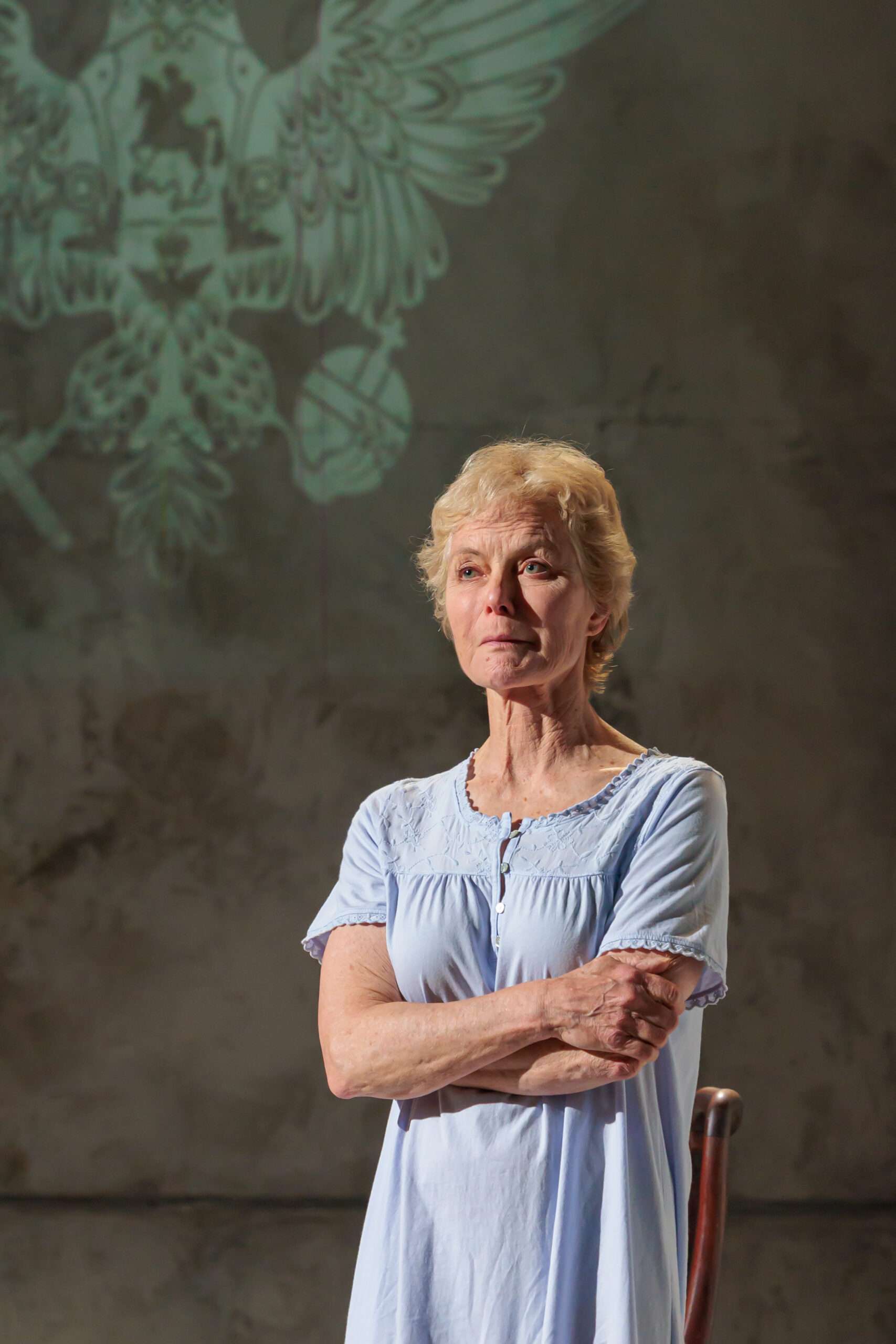

More than a century after the execution of Tsar Nicholas II and his family, the mystery surrounding the fate of Grand Duchess Anastasia continues to fascinate.
Was the youngest daughter of the last Russian Tsar killed alongside her family in Ekaterinburg in 1918, or did she somehow survive?


That question lies at the heart of The Anastasia File, Royce Ryton’s thrilling and moving drama inspired by the true story of Anna Manahan, whose decades-long claim to be the surviving Romanov became one of the most famous historical mysteries of the twentieth century.
Jenny Seagrove, who reprises her critically acclaimed performance in the production, says the story immediately captured her imagination.

“It is the most fascinating and intriguing story,” she says.
The play begins in Berlin in 1920, when a young woman is pulled from a canal following a failed attempt to take her own life. Deeply traumatised and apparently suffering from memory loss, she is placed in an institutional facility while doctors and police attempt to establish who she is.
But there are clues that suggest she is far more than she first appears.
“She speaks good English, German and Russian,” explains Seagrove. “As the story unfolds we learn that she believes that she is the Grand Duchess Anastasia – youngest daughter of Tsar Nicholas II and the sole survivor of the massacre of that family by the Bolsheviks.”
The woman appears to possess an extraordinary knowledge of the Romanov family, including details that would seemingly be impossible for an outsider to know. But as the investigation develops, another motive enters the picture: money.
Her claim to be Anastasia could potentially give her access to a huge Romanov fortune, and suddenly questions of identity become questions of inheritance.
For director Roy Marsden, it was this financial mystery that first led him to the story.
“I found a book at the Goethe Institute in South Kensington discussing how much money Tsar Nicholas invested in the Bank of England before the revolution,” he explains. “A footnote in the book led me to Royce Ryton’s play about the Romanovs and the missing daughter, Anastasia.”
That discovery ultimately inspired Marsden to bring the play back to the stage.
He describes The Anastasia File as “a journey about a woman dragged from a canal in Berlin in 1920 who has lost her memory.”
“Gradually, as the story unfolds, we realise that the woman is not what she seems,” he says. “As the authorities investigate it becomes apparent that the woman is highly educated, hugely knowledgeable and well connected.”
But rather than providing audiences with a definitive answer, the production deliberately leaves the question hanging.
“The play is constructed in such a way as to leave the audience to make up their own mind,” says Marsden. “Is the woman Anastasia, the missing Romanov daughter, or a complete imposter?”
For Seagrove, that ambiguity is one of the things that makes the role so fascinating.
“She is an extraordinary combination of arrogance born of class and privilege and vulnerability,” she says. “So you both love her and dislike her in equal amounts!”
The actress believes audiences may arrive thinking they already know the details, only to discover there is considerably more to uncover.
“People think they know the story but it is the details and the humanity that bring this piece so compellingly to life,” she says. “It has been a real privilege to tell this story and bring Anastasia to life.”
Simon Shepherd, who joins Seagrove in the production, has seen first-hand just how strongly audiences respond to the unanswered question at its centre.

“The Anastasia File is an enigmatic look at one of modern history’s big questions,” he says. “Did Anastasia Romanov die in a massacre alongside her parents and siblings at Ekaterinburg?”
The play, he explains, presents the mystery without forcing an answer. “The audience makes its own mind up throughout the evening.” And that can make for a particularly unusual theatrical experience.
“It’s very rare in my experience as an actor that people want to discuss the outcome of a play like they do this one,” says Shepherd. “And that’s the joy of the evening, I think.”
As the drama unfolds, audiences can feel themselves changing their minds about the woman at its centre.
“As an actor you can feel the audience sway from one opinion to another as the show plays out,” Shepherd says.
Even the actors aren’t necessarily in agreement with themselves!
“So, it’s a mystery you go on and ultimately you will find yourself a pragmatist or an optimistic romantic,” he says. “I personally haven’t made my mind up as I think I’m a bit of both!”
Marsden has approached the production with the intention of keeping the focus firmly on the mystery and the characters, stripping away anything unnecessary.
“I wanted it stripped of any irrelevance,” he says. “Minimal furniture, minimal clutter. Set in an asylum, bare walls, austere.”
The stark setting reflects the unsettling world of the play, where memory, fact and fiction continually collide.
For Marsden, one of the biggest challenges has been ensuring that a story rooted in the past continues to resonate with a modern audience, while also finding moments of humour within an otherwise deeply troubling story.
“Mostly making sure the play keeps its relevance for today,” he says, “and finding comedic lightness within this deeply worrying story.”
And while the question of Anastasia’s identity remains at the heart of the production, Marsden believes another theme runs throughout: the extraordinary power of money.
“It’s to do with money,” he says. “Nearly every character is obsessed with what they can gain from telling the truth or not about Anastasia.”
For Seagrove, however, the story ultimately comes back to the woman herself. “The play begins and ends with Mrs Manahan at 80, having remarried and come to terms with the fact that she has never been able to prove her identity. After a lifetime defined by questions about who she really was, she has found a little happiness and simply wants to be left alone.”
It gives the mystery a deeply human conclusion.
“I feel as though the piece is a real mystery,” says Seagrove. “The audience is drawn in from the very start and taken on a journey back through the earlier stages of Anastasia’s turbulent life.”
Relatives and people who knew her are brought into the story, adding further layers to the enigma.


“Is she really who she says she is?” Seagrove asks. “Does she really not remember things because of the injuries and trauma, or is that just a convenient excuse for a very good imposter?”
There may be no definitive answer waiting at the end of the evening. Instead, audiences are left with the same question that has fascinated historians and the public for generations.
And that, perhaps, is exactly the point.
“The audience inevitably leave the the theatre discussing whether or not she was the real deal,” says Seagrove.
As for the actress herself?
“I know what I feel about her,” Seagrove says, “but I will leave that hidden for people to form their own opinions…”
The Anastasia File plays Newcastle Theatre Royal Wed 16 – Sat 19 Sep 2026. Tickets can be purchased at www.theatreroyal.co.uk or from the Theatre Royal Box Office on 0191 232 7010.
Discover more from InNewcastle.co.uk
Subscribe to get the latest posts sent to your email.